
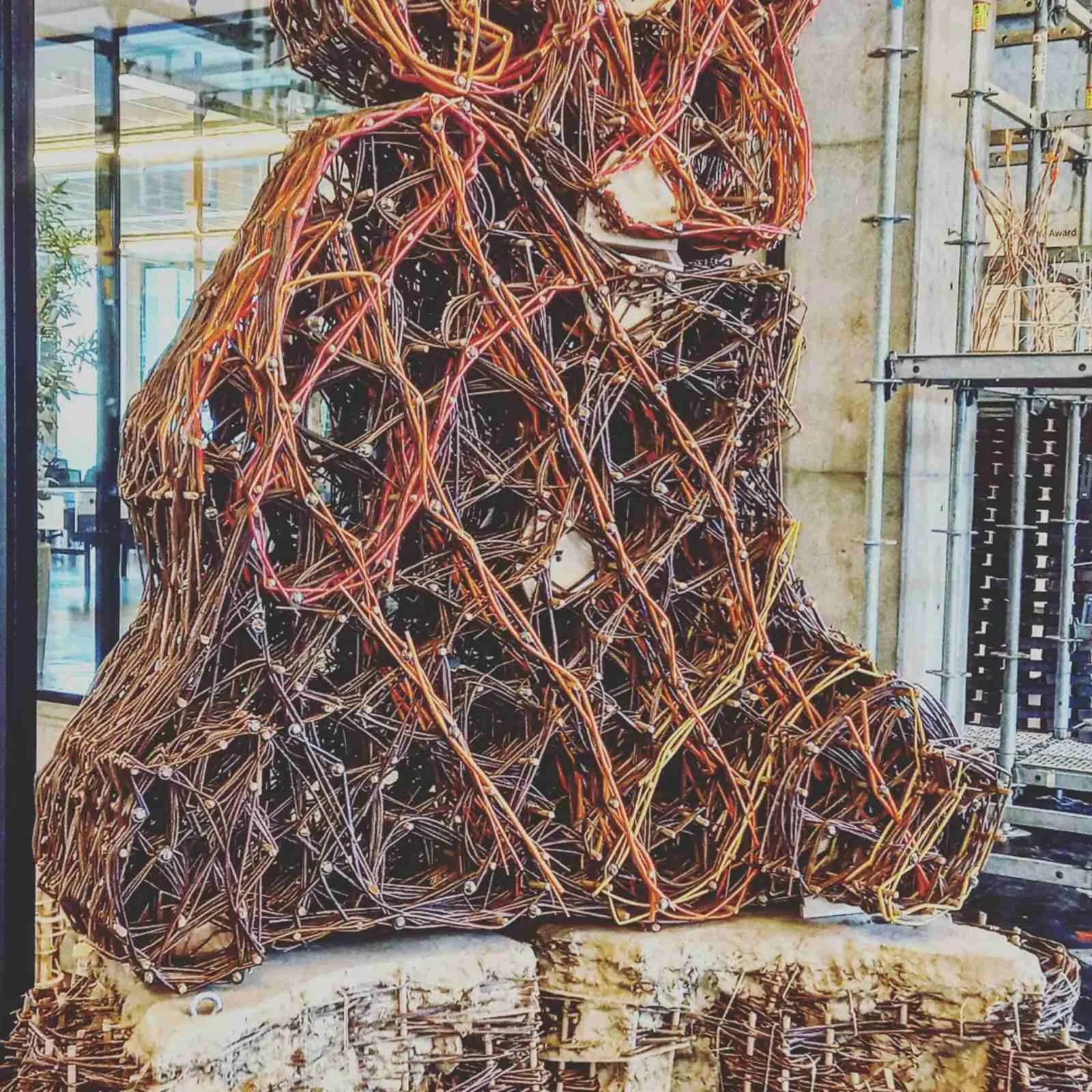
Conference at Eindhoven University of Technology (TU Eindhoven), the Netherlands, November 2022
The conference at Eindhoven University of Technology examined advances in robotic fabrication in relation to craft techniques, versatile materials and cultural aspects of architectural design. Key themes included:
Robotic craft techniques: exploring how robots can reproduce traditional processes such as weaving, knitting and shaping to create new architectural forms.
Versatile materials: using a range of materials, including recycled and sustainable ones, in robotic fabrication.
Cultural and social aspects: discussing the cultural significance and social role of robotic fabrication in architecture.
Interactive demonstrations: large-scale presentations of robotic models and prototypes demonstrating innovations in the field.
Applied technologies and techniques. The exhibition and demonstrations featured a range of robotic approaches, including:
Additive manufacturing: using 3D printing to create complex architectural elements.
Robotic weaving and knitting: integrating textile techniques into architectural design through robots.
Shaping clay and concrete: using robots to create forms and structures from clay and concrete.
"The technology is the answer, but what was the question?" Cedric Price Can robots drive the transition towards sustainable construction? Will/should robots have empathy? Can robots have material sensitivity? Robots, sense and intuition. Cyber-physical communication.
Could technology provide a transition towards sustainable construction and a sustainable future? What should the relationship between people and machines rest on: control and fear, or continuous feedback and collaboration? These questions were present at Robots That Build: The Extensions of Man, Eindhoven 2022. So were natural materials and biomaterials, craft and digitalisation, 3D-printed buildings, parametric design, non-static architecture, collaboration with robots and augmented reality, and the place of artificial intelligence in construction, design and art. Technology may be the answer; it is a fact and is inevitably happening. But what was the question, really? What exactly were we doing, and where are we heading? What is the purpose of technology, and what awaits us? Surely the point is not for people to become unemployed consumers: controlled, absent, unthinking and unfeeling. Quite the opposite. Each of us carries a binary code with which to navigate and create reality: the extraordinary human capacity to think and feel, in zeros and ones. The astonishing cosmic effort of being human… an algorithm with unlimited potential, yet in practice a duality meeting at a single point of equilibrium, at every moment, under particular conditions. Spirit and matter, fullness and emptiness, yin and yang, giving and receiving, inhaling and exhaling, inside and outside, everything and nothing. Whatever future awaits us – or does not 🙂 – a sustainable combination of mind and heart, intellect and intuition is not something anyone can give us or take away. We can only keep learning how to achieve it. A constant pulse, a dance, a small step leading to the next.
Process is more important than the outcome. When the outcome drives the process, we will only ever go to where we’ve already been. If process drives outcome, we may not know where we’re going, but we will know we want to be there…
B2N made it possible for us to take part in this event and encounter the thinking of empathetic, multifaceted contemporary minds, innovators and experimenters such as Alex Dubor / IAAC CATALONIA, Felix Amtsberg / UNIVERSITY STUTTGART, Moritz Dörstelmann / KARLSRUHE INSTITUTE OF TECHNOLOGY, Fabio Gramazio / ETH ZÜRICH, Niccolo Casas / NICOLO CASAS ARCHITECTURE, Roberto Naboni / SOUTHERN DENMARK UNIVERSITY, Remo Pedreschi / UNIVERSITY OF EDINBURGH, Cristina Nan / TU EINDHOVEN, Martyn Dade-Robertson / NEWCASTLE UNIVERSITY, Lidia Ratoi / HONG KONG UNIVERSITY, Oliver Tessmann / TU DARMSTADT, Manuel Jimenez / BARTLETT SCHOOL OF ARCHITECTURE, Mariana Popescu / TU DELFT, and Paul Nicholas and Martin Tamke / ROYAL DANISH ACADEMY.
An authored article presenting personal observations and opinions.
An image from AUTOM8's archived article; an exhibition example.